
Brake Pads Last 30,000 to 70,000 Miles, Less in LA Traffic
November 7, 2026, VIPCANIC Auto Repair
By Anthony Limpert, ASE Business Built With Master Automotive Technicians
Key points
- The usual range is 30,000 to 70,000 miles, per Meineke and a Toyota dealer, with outliers at 20,000 and 100,000
- EPA's LA92 trace makes 16 stops in 9.8 miles. The highway trace makes 1 stop in 10.3 miles
- By our count, LA92 takes about 6 times the firm braking per mile
- Two thickness readings give you your own miles per millimeter
- Regen means hybrid and EV brakes generally last longer, but hybrid rear pads can wear as fast as the fronts
- A pad set ran $50 to $90 on our invoices. A rotor line ran $178 to $245, so waiting can cost more
30,000 to 70,000 miles. Meineke gives that range for brake pads. So does a Toyota dealer in Dallas. It's a fair start. It's also a huge spread, and South Bay streets push you toward the low end.
Two federal speed files show why. EPA's LA92 trace makes 16 full stops in 9.8 miles. Its highway trace makes 1 stop in 10.3 miles, and that stop ends the test. By our count, LA92 takes about 6 times the firm braking per mile.
So two cars can show the same odometer and very different pads. One crawls down Hawthorne Boulevard every day. The other runs open freeway at night. Mileage alone won't tell them apart.
Why the Odometer Misleads in LA
These traces aren't random. EPA says its city test, the UDDS, is commonly called the LA4. That name traces to a 12 mile figure eight loop near downtown Los Angeles. LA92 is the Unified Cycle from the California Air Resources Board. UC Riverside researchers call it an improved cycle, built because older test cycles no longer matched real traffic.
California's driving studies from that era went right at our roads. A 1993 report describes a chase car with a laser range finder. It followed hundreds of vehicles on random routes around greater Los Angeles.
We ran the speed files EPA posts and counted two things.
| EPA Trace | Miles | Full Stops | Stops per 10 Miles | Firm Braking per Mile |
|---|---|---|---|---|
| New York City Cycle | 1.2 | 10 | 84.9 | 9.4 times highway |
| LA92 | 9.8 | 16 | 16.3 | 6.2 times highway |
| US06, aggressive driving | 8.0 | 5 | 6.2 | 5.7 times highway |
| UDDS, the city test | 7.5 | 17 | 22.8 | 4.7 times highway |
| Highway test | 10.3 | 1 | 1.0 | Baseline |
How we counted. EPA's files list speed once per second. A stop is any time speed hits zero. Firm braking is the speed energy a car sheds while slowing by 1 mph per second or more. That cutoff is our call. Count every slowdown and LA92 falls to 3.2 times the highway trace. Raise the cutoff to 2 mph per second and it climbs to 8.4. The files have no hills, no regen and no car weight. This compares brake load. It isn't a pad wear test.
Look at US06. It's EPA's aggressive trace, with only 5 stops. It still lands close to LA92. A heavy right foot can do what traffic does.
A Better Guess for Your Commute
Six times the braking doesn't mean one sixth the pad life. Nobody's baseline is all highway. So we built a worked example from the numbers above.
Start with 50,000 miles, the middle of the usual range. Give that to a car on EPA's 55 percent city, 45 percent highway mix. Then change the mix and scale the pad life by the 6.2 ratio. We assume wear follows brake load. That's a simplification, so treat every row as a planning number.
| Your Driving | City Share | Pad Life, Worked Example | Years at 12,000 Miles a Year |
|---|---|---|---|
| Surface streets only | 100% | 31,000 miles | 2.6 |
| Streets plus a jammed 405 | 90% | 34,000 miles | 2.8 |
| Mostly city, some open freeway | 75% | 39,000 miles | 3.3 |
| EPA's usual mix | 55% | 50,000 miles | 4.2 |
| Mostly open freeway | 25% | 84,000 miles | 7.0 |
The answer holds up. Use the lower 3.2 ratio and the surface street row only moves to about 34,500 miles. So a car that lives on South Bay streets should plan on 30,000 to 40,000 miles.
Count a stopped 405 as city miles. The pedal doesn't care that you're on a freeway. Hills add their own load, and the traces leave them out. If you drive the Palos Verdes grades every day, read our post on brake fade on long grades.
The bottom row is the rare one. Meineke says some pads pass 100,000 miles and others need replacing at 20,000. Ulrich Ford calls 100,000 rare and not typical.
Measure Your Own Pad Life in Two Visits
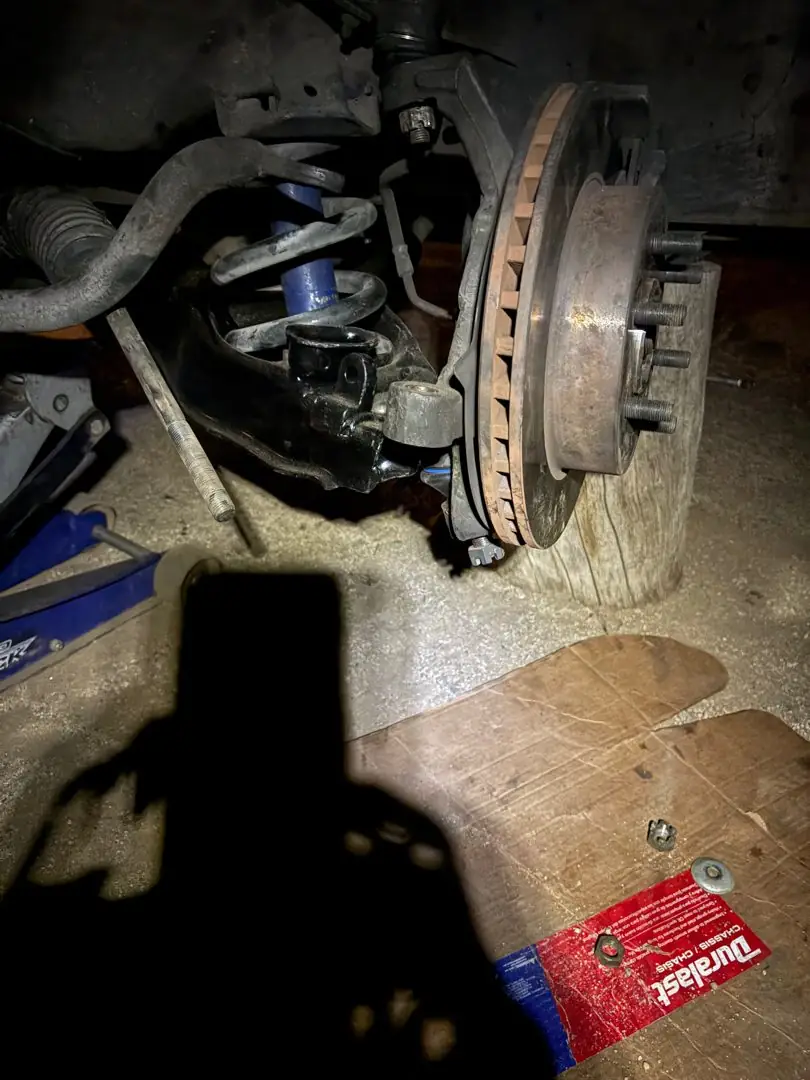
Any range is still a guess. Two readings give you your own number. All it takes is a shop that writes down millimeters instead of "good."
- Get a first reading. Ask for the pad thickness at each corner, inner and outer. Write it down with the odometer.
- Get a second reading. Do it at your next tire rotation or oil change.
- Find your rate. Divide the miles driven by the millimeters lost.
- Find what's left. Multiply that rate by the millimeters left above 3.
Say a front pad reads 9 mm at 40,000 miles and 7 mm at 48,000. That's 2 mm in 8,000 miles, or 4,000 miles per millimeter. You have 4 mm above the line. That's about 16,000 more miles. This is a worked example, so use your own readings.
Why stop at 3? Legacy Toyota's chart puts new pads at 10 to 12 mm. It says to plan on replacement at 4 to 5 mm, and calls 3 mm the minimum safe level. At 2 mm or less, replace them now. Your owner's manual may differ, and it wins.
Use the thinnest pad on the axle. The outer pad is the one you can see through the wheel. The inner one can be thinner, and you won't see it from the curb.
Hybrids, EVs, Trucks and the Rear Axle
Plenty of South Bay cars don't fit the usual range. Regen changes the job.
- Hybrids and plug-ins. The Department of Energy says their brake systems generally last longer because of regenerative braking. Stop-and-go is where regen works. So LA traffic costs a hybrid far less than it costs a gas car.
- Full electrics. The same page says brake wear is significantly reduced. It gives no mileage. Neither will we.
- The final few mph. Legacy Toyota says the handoff to friction brakes comes at roughly 7 to 17 mph on its hybrids. Hard stops suspend regen, so a panic stop still uses the pads.
- Rear pads on hybrids. On a gas car, the front axle does about 70 percent of the stopping, per Legacy Toyota, so fronts go first. On hybrids, it says rears can wear about as fast, or faster. Have all four measured.
- Trucks and big SUVs. Meineke says heavier vehicles put more stress on pads. It gives no figures, and we don't have a clean one. Measure and use your own rate.
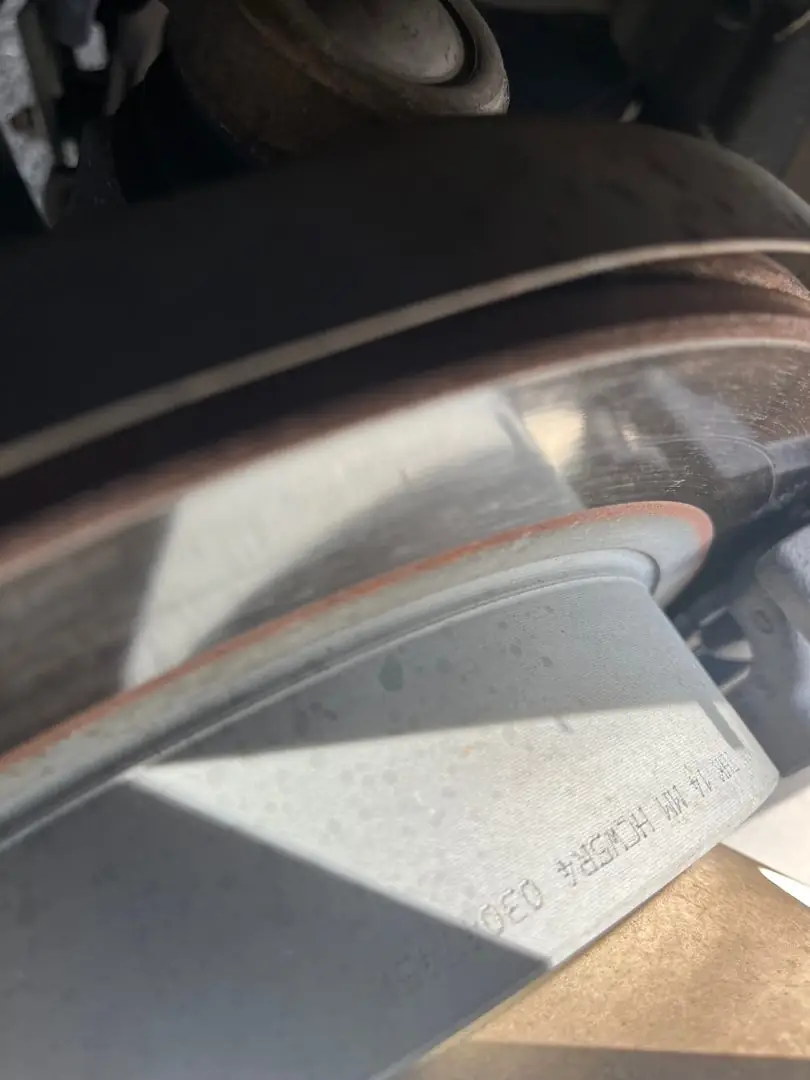
California adds one wrinkle. State law set a 5 percent copper limit in 2021, on the way to under 0.5 percent by 2025. The last three characters of the mark on the pad show its compliance level. That rule is about copper, not pad life. Don't read a pad's lifespan from that mark.
What Waiting Costs
Pads are the cheap part. On itemized Supercanic invoices, a pad set ran $50 to $90 and a rotor line ran $178 to $245. A typical one axle bill was $254 across 22 paid jobs from October 2025 to October 2026, mostly in the Inland Empire. The full breakdown is in our post on brake job prices in Los Angeles.
Now see what stretching a pad buys. You might save a few thousand miles of a $50 part. Run it to the backing plate and you can add a $178 rotor. That's a bad trade.
A squeal can be an early warning. A grind usually means metal on metal. Our post on why brakes squeal sorts out which sound means what.
Wrong Turns
- "You're at 50,000, so they're due." Legacy Toyota says Toyota publishes no mileage interval for pads at all. Thickness decides. Ask to see the reading.
- "It's been three years." Years only work as miles divided by your yearly driving. At 5,000 miles a year, a 50,000 mile set is a 10 year set.
- "Ceramic will fix it." Meineke says higher quality pads generally last longer. It gives no numbers. We couldn't find a public test that puts firm miles on ceramic against semi-metallic in LA traffic. Better pads can help. They won't erase 16 stops every 10 miles.
- Treating the range as a promise. A 30,000 to 70,000 range covers almost every car. It can't tell you about yours. Two readings can.
- New pads, same foot. Remember US06. Lift early for the red light on Crenshaw. Leave more room. Every stop you coast into is one the pads don't pay for.
Want a real reading? Our mobile brake repair crew can measure all four corners in your driveway and write down the numbers.
The Questions That Keep Coming
How long do brake pads usually last?
Usually 30,000 to 70,000 miles, according to Meineke. On South Bay streets, plan on 30,000 to 40,000. That second range is our worked example from EPA speed data, not a measured test.
How many miles to replace brake pads?
No mileage is the right one. Replace them by thickness. Legacy Toyota says to plan on it at 4 to 5 mm and calls 3 mm the minimum safe level. Check your owner's manual too.
How many years should brake pads last?
Divide the miles by your yearly driving. At 12,000 miles a year, 30,000 miles is 2.5 years and 70,000 miles is about 5.8 years. Short city trips usually put you at the low end.
Do brake pads last 3 years?
Often, yes. In our worked example, a car on mostly South Bay streets at 12,000 miles a year gets about 2.6 to 3.3 years. A low mileage car can go much longer.
Can brake pads last 100,000 miles?
It can happen, but don't plan on it. Meineke says some pass 100,000 miles. Ulrich Ford calls that rare. Mostly open freeway miles and a light foot give you the best shot.
Do front brake pads wear faster than rear pads?
Usually, on a gas car. Legacy Toyota says the front axle does roughly 70 percent of the stopping. On hybrids, it says rear pads can wear about as fast as the fronts, or faster.
How long do brake pads last on a hybrid?
Longer than on a similar gas car, generally. The Department of Energy credits regenerative braking but gives no mileage. So measure the pads rather than trusting a number, and check the rears.
VIPCANIC measures and replaces brake pads at the curb in Hawthorne, Torrance and the rest of the South Bay, 24 hours a day. (310) 340-6775.
Anthony Limpert is a co-founder and lead technician at Supercanic, the parent company behind VIPCANIC.
Like our car repair posts? See more of them when you search.
Star VIPCANIC as a source in GoogleLinks and Records
EPA, Dynamometer Drive Schedules, speed files for LA92, UDDS, US06, New York City Cycle and the highway test. Stops and firm braking counts are our own analysis of those files
FuelEconomy.gov, Learn More About the Fuel Economy Label, 55 percent city and 45 percent highway weighting
US Department of Energy, Alternative Fuels Data Center, Maintenance and Safety of Electric Vehicles
California Bureau of Automotive Repair, Understanding California's Brake Pad Law, Spring 2021
Austin and others, Characterization of Driving Patterns and Emissions From Light-Duty Vehicles in California, 1993
Younglove, Scora and Barth, Designing On-Road Vehicle Test Programs for the Development of Effective Vehicle Emission Models, UC Riverside, 2005
TransportPolicy.net, California Light-Duty Unified Cycle Test
Wikipedia, UDDS
Meineke, How Long Do Brake Pads Last and When to Change Them, May 10, 2017
Legacy Toyota of Dallas, How Long Do Car Brakes Last
Ulrich Ford Lincoln, How Long Do Brake Pads Last, March 20, 2026
Supercanic paid final invoices, October 30, 2025 to October 13, 2026, 22 one axle brake jobs plus itemized bills, as reported in our brake job price post (our own data)
Stranded, stuck, or just done with repair shops?
One call and a VIPCANIC mechanic is on the way. 24 hours a day, anywhere in the South Bay.
Call (310) 340-6775